

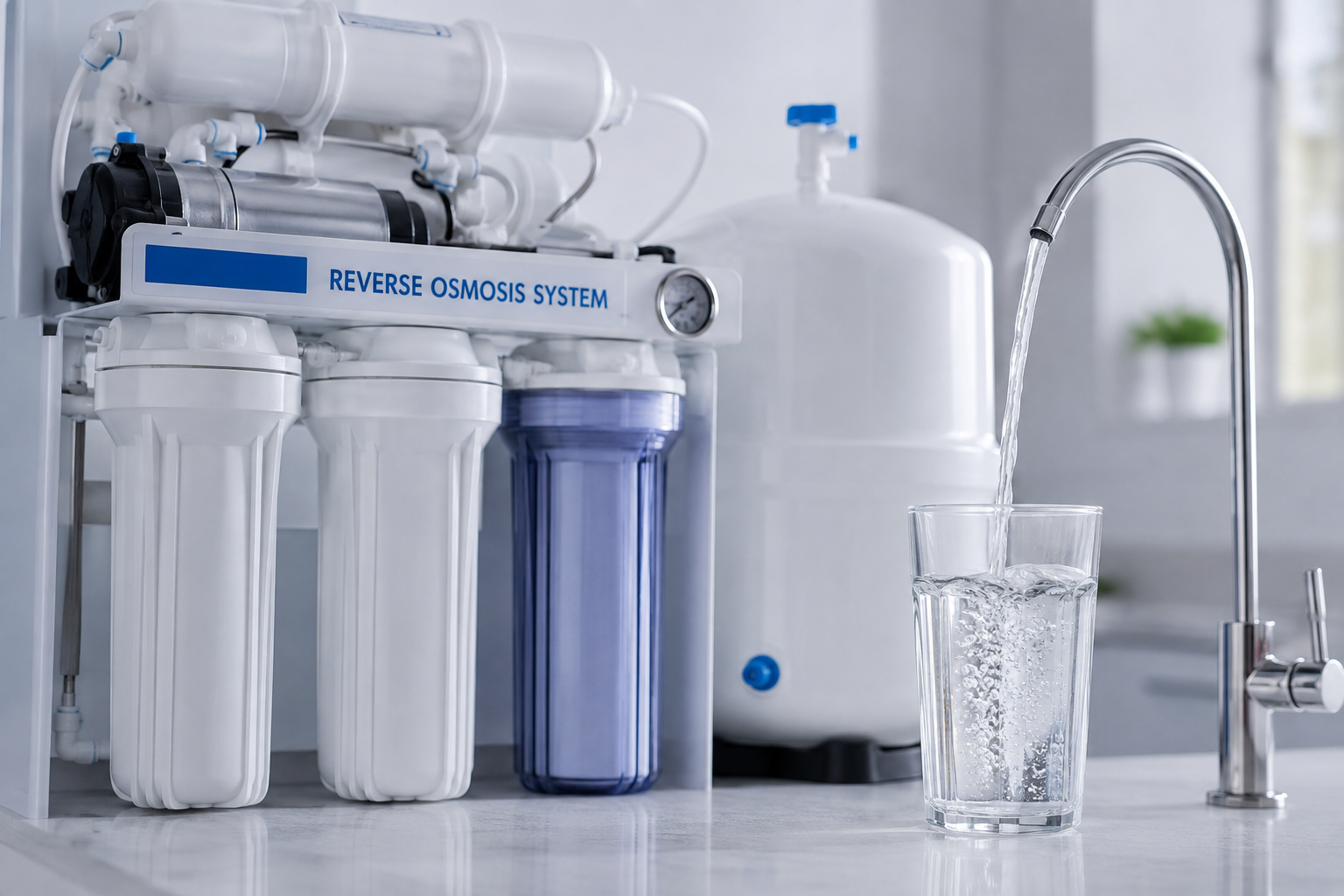
If you’ve been researching water purification options, you’ve likely come across RO water as one of the most common choices for homes and offices.
Direct Answer: RO (Reverse Osmosis) water is water that has been forced through a semi-permeable membrane to remove dissolved salts, contaminants, heavy metals, and impurities. It’s one of the most effective purification methods available for household drinking water, and when paired with additional steps like UV and ozone treatment, it also protects against bacteria and viruses that RO membranes alone may not fully address.
Reverse osmosis has become the standard purification method for homes and offices because it removes a wide range of contaminants that boiling or basic filters can’t touch. But not all RO water is the same — how it’s processed after filtration matters just as much as the filtration itself.
Whether you’re purifying water for your kitchen or supplying it across your home and office, understanding how RO works helps you make an informed choice.
How Does RO Purification Work?
RO systems push water under pressure through a membrane with microscopic pores — small enough to block dissolved salts, sediment, heavy metals, and many chemical contaminants, while letting water molecules pass through. The result is water stripped of most impurities found in untreated tap or borewell water.
The trade-off: standard RO systems also remove naturally occurring minerals along with the contaminants, which is why plain RO water can taste flat and why remineralization is an important extra step.
Is RO Water Safe to Drink?
Yes — RO purification is widely recognized as an effective way to reduce contaminants in drinking water, including sediment, heavy metals, and many dissolved chemicals. That said, “safe” depends heavily on the system’s maintenance and how the water is processed afterward:
- Membrane maintenance: RO membranes need regular replacement; a neglected system loses effectiveness over time.
- Post-filtration handling: Water sitting in poorly maintained storage tanks can pick up contamination after purification.
- Mineral balance: Long-term reliance on plain, non-remineralized RO water is a common concern people raise, which is why quality RO systems reintroduce minerals after filtration rather than leaving the water stripped.
RO Water vs. Mineral Water: What’s the Difference?
These aren’t the same category of water. Mineral water naturally originates from a protected underground source and carries its own inherent mineral profile. RO water starts as regular tap or ground water and is purified through filtration — any minerals present afterward were added back in through a separate remineralization step, not sourced naturally.
Neither is automatically “better” — what matters is verified water quality: consistent lab testing, contaminant removal, and balanced mineral content, regardless of which category the water falls into.
Beyond Basic RO: Why Multi-Stage Purification Matters
Standard RO filtration is effective against dissolved solids and many contaminants, but it isn’t designed to eliminate all microbiological risks on its own. This is why more advanced systems combine multiple purification layers:
- RO Filtration — removes dissolved salts, heavy metals, and sediment.
- UV Treatment — neutralizes bacteria and viruses that may pass through the membrane stage.
- Ozone Treatment — provides an additional layer of disinfection and helps maintain water freshness during storage and delivery.
- Controlled Remineralization — reintroduces essential minerals in balanced proportions, addressing the “flat taste” issue of plain RO water.
Combined, this multi-step process — RO + UV + Ozone plus remineralization — addresses the two most common concerns people raise about RO water: safety beyond basic filtration, and mineral loss.
This is exactly the kind of multi-layered purification process we follow to ensure every drop meets a consistent safety and taste standard.
Frequently Asked Questions
Is RO water safe to drink daily? Yes, when the system is properly maintained and regularly tested. Well-maintained RO purification, especially when combined with additional steps like UV and ozone treatment, is considered a safe and effective way to purify drinking water for daily use.
Does RO water remove essential minerals? Yes, standard RO filtration removes most dissolved minerals along with contaminants. This is why many quality purification systems include a remineralization step afterward, to reintroduce essential minerals like calcium, magnesium, and potassium in controlled amounts.
Is RO water the same as mineral water? No. Mineral water comes from a naturally sourced underground spring with its own mineral profile. RO water is purified tap or ground water that may have minerals reintroduced through a separate remineralization process — they are different categories, though both can be safe to drink.
What’s better than plain RO filtration? Multi-stage systems that combine RO with UV and ozone treatment offer broader protection than RO alone, since they add disinfection layers that address bacteria and viruses beyond what RO membranes typically filter out.
Multi-stage systems that combine RO with UV and ozone treatment offer broader protection than RO alone, since they add disinfection layers that address bacteria and viruses beyond what RO membranes typically filter out. If you’d like water that goes through this complete process, you can explore our purified water delivery options.